ChatGPT will not audit your Search Console data, and it will not tell you why a page dropped from position 6 to position 14. What it is genuinely good at is faster: turning a keyword list into content clusters, turning a brief into a draft, and turning a blank meta description field into three usable options in ten seconds. This is a task-by-task workflow for the parts of SEO ChatGPT actually helps with, the prompts that work, and the parts you should not hand it.
What ChatGPT Is Actually Good For in SEO
Most "ChatGPT for SEO" content either oversells it as a full replacement for an SEO tool, or lists twenty generic prompts with no order to them. Neither is useful on a Tuesday morning when you have an actual page to write.
ChatGPT is a language and reasoning tool, not a data tool. It has no live connection to Google Search Console, no crawler, and no rank tracker unless you explicitly connect one. What it does well is working with information you give it:
- Turning a raw keyword list into logical topic clusters
- Expanding one keyword into a full content brief with subtopics and questions to answer
- Drafting an outline, an intro, or a full first draft from that brief
- Writing meta titles and descriptions inside a strict character count
- Generating schema markup (FAQ, HowTo, Article) as valid JSON-LD
- Summarizing a competitor's page you paste in and pointing out what it covers
That is the honest scope. Everything below assumes you already have your own keyword data (from Google Search Console, Google Keyword Planner, or a paid tool) and are using ChatGPT to process it faster, not to invent it from nothing.
The 6-Task ChatGPT-for-SEO Workflow
Here is the order that actually works in practice, going from research to a published, indexable page.
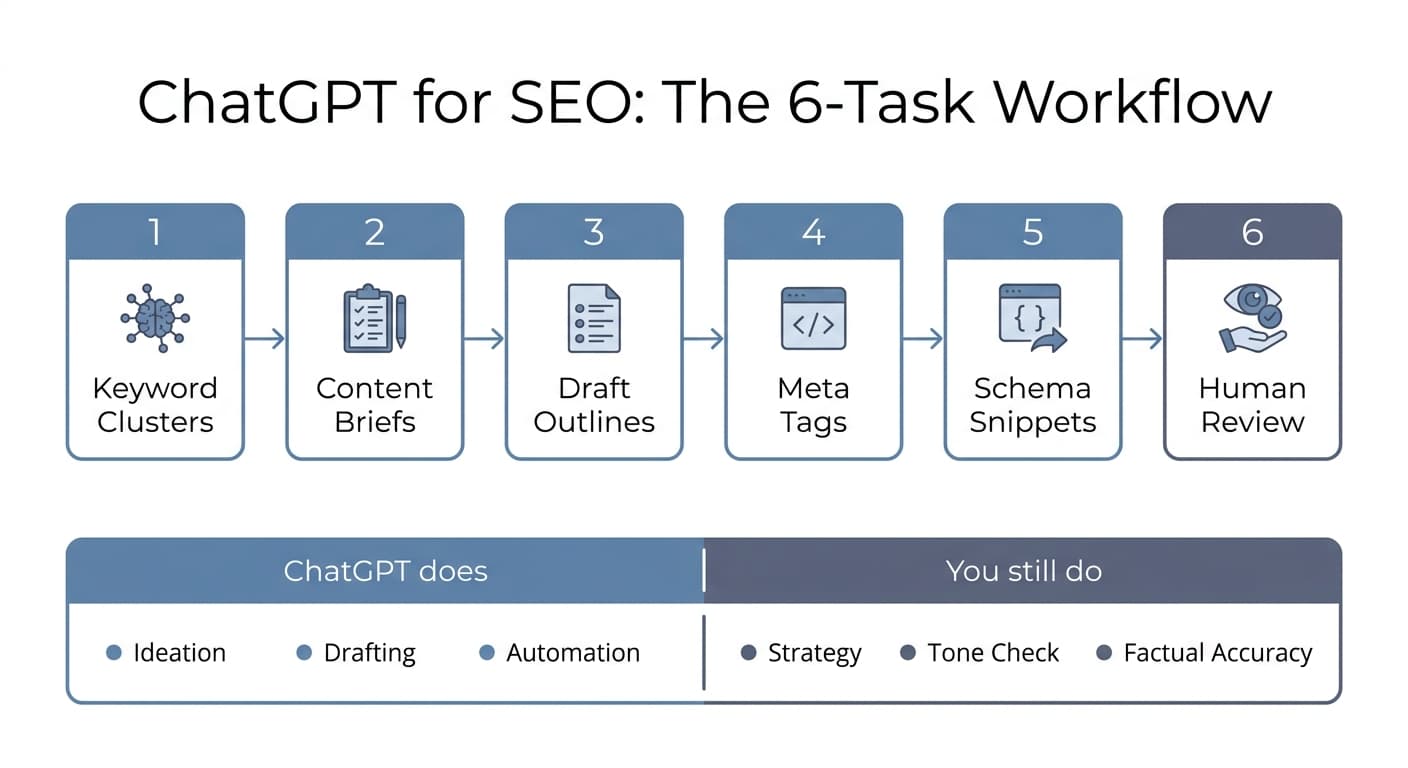
Task 1: Cluster Keywords Into Topics
Paste a raw keyword export (50 to 200 keywords is a manageable batch) and ask ChatGPT to group them by search intent and topical overlap, not just by shared words. A prompt that works:
"Group these keywords into topic clusters based on search intent (informational, commercial, transactional). For each cluster, name the head term and list the keywords under it. Flag any keyword that seems ambiguous or could belong to two clusters."
ChatGPT is reliably good at this because it is a pattern-matching job over text you already gave it, not a judgment call about which keywords are worth pursuing. It will not tell you a cluster has real search volume or winnable competition. For that, keyword data still has to come from a tool that actually measures volume and difficulty, then you bring the shortlist back to ChatGPT to cluster.
Task 2: Turn a Keyword Into a Content Brief
Once you have a target keyword, ask ChatGPT to build the brief rather than the draft. This step catches gaps before you write a single sentence.
"I'm writing an article targeting the keyword '[keyword]', search intent [informational/commercial]. List: the subtopics a comprehensive article should cover, 5 questions a reader would want answered, a suggested H2/H3 outline, and any related keywords I should work in naturally."
This is where ChatGPT earns its keep on structure. It has read enough well-structured articles to suggest a sane outline. It has not read today's actual top 3 ranking pages for your specific keyword, so treat its outline as a starting point, then check the live SERP yourself (or paste in the top 3 competitors' text) and ask it to compare.
Task 3: Draft, Don't Publish
Feed the approved brief back in and ask for a full first draft. This is the step every "ChatGPT for SEO" guide leads with, and it is genuinely the least interesting one, because a first draft from any LLM reads recognizably like an LLM wrote it: safe, a little generic, confident about things it should not be confident about.
Use it for the first draft, never the final one. The value is eliminating the blank page, not eliminating the edit. A useful habit: paste in a few paragraphs of your own past writing and ask ChatGPT to match that voice, rather than accepting its default tone.
Task 4: Meta Titles and Descriptions
This is the single highest-value, lowest-risk use of ChatGPT in SEO, because the constraint (character count) is exactly the kind of rule an LLM follows precisely, and the cost of a bad draft is zero since you are picking from options, not publishing blind.
"Write 5 meta titles under 60 characters and 5 meta descriptions between 150 and 160 characters for a page about [topic], targeting the keyword '[keyword]'. Include a clear benefit or reason to click in each description."
Always count characters yourself before publishing. ChatGPT undercounts and overcounts character limits often enough that you cannot skip the check.
Task 5: Schema Markup
Ask ChatGPT to generate JSON-LD for FAQ, HowTo, or Article schema from content you already have, rather than from scratch. It is reliable at the syntax; it is not reliable at knowing which schema type Google currently supports for rich results, since that changes and its training data has a cutoff.
"Generate valid FAQPage JSON-LD schema for these 5 question-and-answer pairs: [paste Q&As]. Output only the script tag."
Validate the output in Google's Rich Results Test before you ship it. A syntax error in schema is invisible until a validator catches it.
Task 6: Human Review, Every Time
The step that is not optional. Read the draft for factual accuracy, check every stat against a real source, confirm the brand voice actually sounds like your brand, and verify internal links go to pages that exist. An LLM will state a wrong statistic with the same confidence as a correct one. This is not a ChatGPT-specific flaw, it is true of every generative model, and it is the reason none of the previous five tasks should end with "publish" instead of "review."
A Worked Example: One Keyword, Start to Finish
Say your target keyword is "content refresh strategy," informational intent, with meaningful search volume you already confirmed in Search Console or a keyword tool.
- Cluster. Paste 40 related keywords; ChatGPT groups "content refresh," "content decay," and "content pruning" into one cluster and flags "content audit" as ambiguous, since it could be its own page.
- Brief. Ask for a brief on "content refresh strategy." It suggests covering when to refresh vs. rewrite, how to prioritize pages, a step-by-step process, and five likely reader questions.
- Draft. Paste the approved brief back in. It returns something reasonably organized but generic in tone and light on specifics.
- Meta. Generate five title and description options, check the character counts, pick the sharpest one.
- Schema. Draft FAQPage JSON-LD from the final FAQ section and validate it.
- Review. Rewrite the intro in your own voice, fix a stat the draft invented about "average content decay rates," add one real example from your own site, confirm every internal link resolves. Only then does it publish.
Five of six steps ran faster because of ChatGPT. The step that actually protects your site's credibility, step 6, still took a person.
Where ChatGPT Falls Short for SEO
Being clear about the limits is what separates a useful workflow from a demo. ChatGPT, on its own, cannot:
- See your actual rankings. No connection to Google Search Console or a rank tracker unless you build that connection yourself.
- Diagnose why a specific page dropped. It can suggest generic reasons pages lose rankings, but it cannot look at your page, your competitors' current pages, and Google's own signals to tell you what actually happened this month.
- Catch its own factual errors. It states invented statistics and outdated facts with full confidence. Every number in an AI draft needs a source check.
- Know what changed in Google's algorithm last week. Its knowledge has a training cutoff; for anything time-sensitive, check current sources, not ChatGPT's default answer.
- Replace keyword research data. It can cluster and expand keywords you already have, but it cannot tell you real search volume or ranking difficulty, since it has no live index of search behavior.
<mark class="km-highlight" style="--hl:#FEF08A;background:#FEF08A">The pattern across every task above: ChatGPT is fast at production, not verification. Treat every output as a draft from a fast, unpaid junior writer, not a finished deliverable.</mark>
ChatGPT SEO Tools Worth Knowing About
Beyond the plain chat interface, a few extensions turn ChatGPT from a text generator into something closer to a connected tool. Custom GPTs built by other SEOs handle specific tasks like schema generation or content grading, though it is worth checking the underlying prompt before trusting one on client work. MCP (Model Context Protocol) connectors link ChatGPT or Claude to real data, such as a Search Console export, so the model reasons over your actual numbers instead of what you paste in manually. Browsing-enabled modes let ChatGPT check a live page or current SERP rather than relying only on training data, useful for competitor teardown, unreliable for anything needing pixel-perfect accuracy. None of these turn ChatGPT into an autonomous SEO system on their own; they reduce the copy-pasting, not the review step. For dedicated products built on top of language models, see our comparison of AI tools for SEO.
ChatGPT vs. a Dedicated SEO Platform
The honest comparison is not "which is better," it is "which job is each one actually built for."
| ChatGPT | Dedicated SEO platform | |
|---|---|---|
| Sees your live rankings | No, unless manually connected | Yes, pulled from Search Console automatically |
| Detects a ranking drop unattended | No | Yes, on a schedule |
| Drafts content from a brief | Yes | Varies; often built on the same underlying models |
| Generates meta tags and schema | Yes, reliably | Yes, usually templated |
| Publishes directly to your CMS | No | Often yes, one-click |
| Tracks whether a fix actually worked | No | Yes, if it re-checks rankings after publish |
| Cost | Free tier, or ~$20/mo for Plus | Varies by platform and page count |
ChatGPT is the tool for the writing and structuring tasks. It was never built to watch your Search Console data every morning, notice a page sliding down the results, and tell you before your traffic report does. That gap is exactly what tools built specifically for SEO automation exist to close, by wiring the detection step to the drafting step so nothing waits on someone remembering to check.
Where Murkuz Fits Into This Workflow
Murkuz does not replace ChatGPT for drafting, it replaces the parts of the workflow ChatGPT was never built to do. Murkuz's AI Search Gaps detection specifically grades your pages A to F on how ready they are to be surfaced or cited by ChatGPT, Perplexity, and Google AI Overviews, then hands you a fix instead of just a grade. Its BYOK (Bring Your Own Key) setup lets you connect your own OpenAI key, so the same model family behind ChatGPT is doing the drafting inside a workflow that already knows which pages are declining and pushes the approved fix straight to WordPress, Webflow, or Framer.
The six tasks above still apply either way. The difference is whether you are manually triggering each one from a keyword list you remembered to check, or a tool is running the detection step continuously and only asking you to review the draft it already generated.
FAQ
Which AI is best for SEO?
There is no single best model for every task. ChatGPT and Claude are both strong at drafting, outlining, and structured tasks like schema generation. The bigger differentiator for SEO specifically is not which chat model you use, but whether it is connected to real data (your Search Console, your rankings) or working only from what you paste in.
What is SEO for ChatGPT called?
Optimizing your own content so it gets surfaced or cited inside ChatGPT's answers is usually called GEO (Generative Engine Optimization) or AEO (Answer Engine Optimization). That is a different task from using ChatGPT as an SEO tool, which is what this article covers.
How do I use ChatGPT for keyword research?
ChatGPT can expand a seed keyword into related terms and questions, and it can cluster a keyword list you already have by topic and intent. It cannot tell you real search volume or competition, since it has no live connection to search data. Pair it with an actual keyword tool for the numbers, then use ChatGPT to organize the list.
Can ChatGPT write a full SEO article on its own?
It can produce a complete first draft from a good brief, but publishing it unedited is a real risk: unverified stats, generic phrasing, and no guarantee it actually beats what is currently ranking. Treat the output as a first draft that needs a human fact-check and voice edit before it goes live.
Is ChatGPT better than dedicated SEO tools?
They are not really competing for the same job. ChatGPT is strong at language tasks: drafting, outlining, meta tags, schema. Dedicated SEO platforms are built to monitor your actual rankings and Search Console data continuously, something ChatGPT cannot do without a separate data connection. Most practical workflows use both.
Junaid Khalid is the founder of Ertiqah and the builder of Murkuz. He has run SEO as the first growth channel across his own SaaS products, and built Murkuz's AI content engine around the same models behind ChatGPT, connected directly to real ranking data instead of a blank chat window.