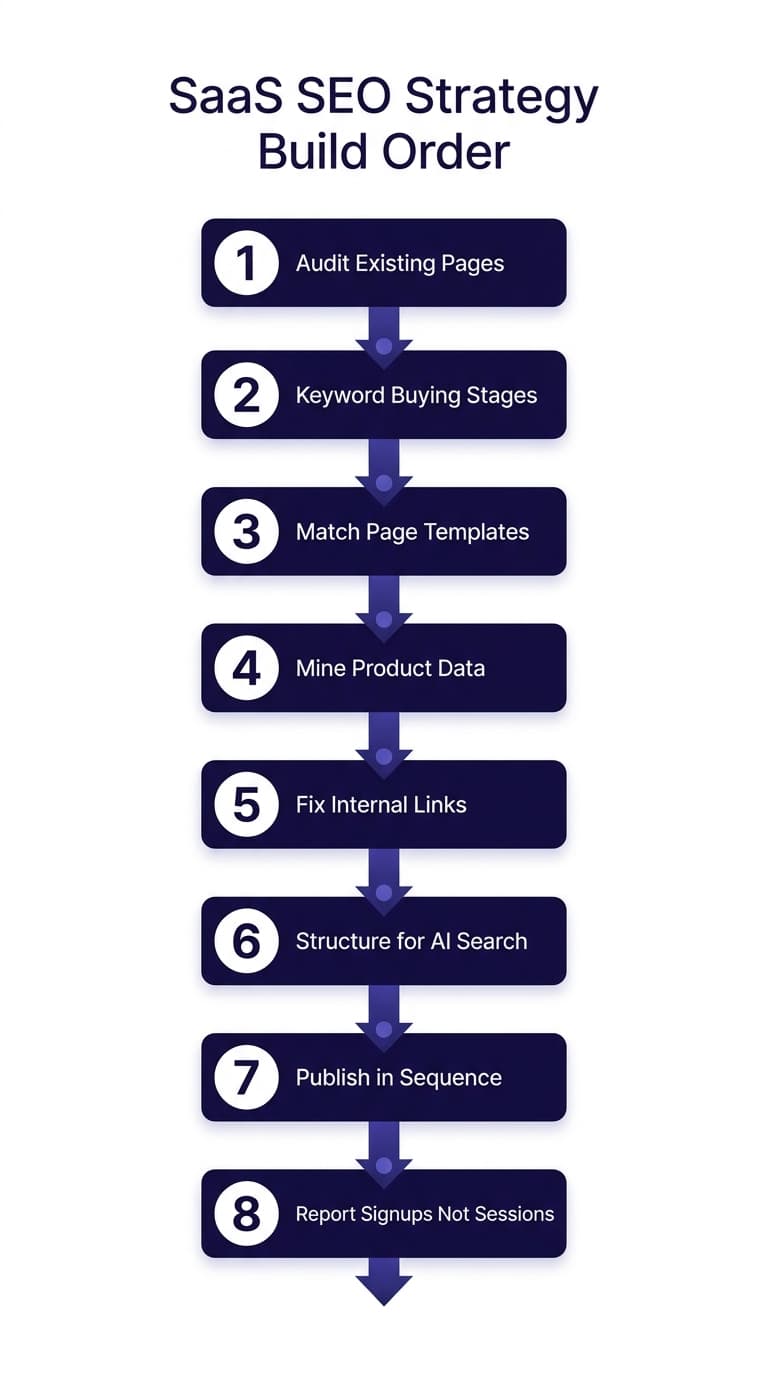
Most guides to SaaS SEO strategy are lists of tips in a trenchcoat: do keyword research, fix your technical SEO, build some links, repeat. None of them tell you what to do first, second, and third. This is the version with a real order of operations: eight steps, done roughly in sequence, that take a SaaS product from no organic strategy to a working content engine that produces pipeline instead of just traffic.
The short version: audit what you already have before writing anything new, build a keyword list organized by buying stage rather than volume, pick page templates that match each stage (including programmatic ones for anything that repeats), mine your own product for content ideas, fix your internal linking, structure every page for AI answer engines, publish in sequence, and report on signups, not sessions. The rest of this guide walks through each step with enough detail to execute it. For the fuller framework behind each step, see our SaaS SEO strategy pillar and the tactical companion, SEO for SaaS companies.
Step 1: Audit What You Already Have (Before Writing Anything New)
Every SaaS company under-audits and over-writes. Before you plan a single new article, spend a day finding out what your existing pages are actually doing in Google Search Console. Pull three reports:
- Pages ranking positions 11-20. These are your fastest wins. A page on page two is usually one solid refresh away from page one, and refreshing a page with real authority is faster than ranking a new one from zero.
- Pages that lost more than 20% of impressions over the last 90 days. This is content decay: a page that used to work and is quietly losing ground, usually because competitors published something fresher, the SERP shifted toward AI answers, or your product changed and the page did not.
- Pages competing with each other for the same query. If two of your own URLs both show up for "project management software for agencies," you are splitting your own ranking signal, and Google often guesses wrong for both.
This audit is the single highest-leverage hour you can spend before building a strategy, because it tells you whether your first move should be new content at all, or fixing what already exists.
Step 2: Build a Keyword List Organized by Buying Stage, Not Volume
Once you know what you have, decide what to add. The mistake almost every SaaS content calendar makes is sorting keywords by search volume and working top-down. That produces a blog full of broad, top-of-funnel posts that get traffic and never convert, because the person searching a 5,000-a-month generic term is nowhere near ready to buy software.
Sort keywords into stages instead, and weight your effort toward the bottom, not the top:
| Stage | Example query pattern | What they want | Priority |
|---|---|---|---|
| Bottom-of-funnel (BOFU) | "[competitor] alternatives," "[your category] pricing," "[competitor A] vs [competitor B]" | To choose between tools right now | Highest, do first |
| Feature / job-to-be-done | "[feature] for [role]," "how to [specific outcome] with software" | A specific problem solved | High |
| Mid-funnel | "how to [broader task]," "[category] checklist," "[category] best practices" | Evaluating approaches, not vendor-shopping yet | Medium |
| Top-of-funnel (TOFU) | "what is [concept]," "[industry] trends" | Early research, building awareness | Low, do last |
This is not a minor reordering. It is the difference between a blog that reports rising sessions and a blog that reports rising trial signups. A BOFU keyword with 150 monthly searches from people who have already decided to switch software will out-convert a TOFU keyword with 4,000 monthly searches from people doing early research, every time.
Step 3: Match Every Keyword to a Page Template, Not a One-Off Article
Once your keyword list is stage-sorted, the next decision is format. Most SaaS SEO advice treats every keyword as "write a blog post about it," which is why so many SaaS blogs are a pile of similar 1,200-word articles that never rank for anything commercially useful. Match each stage to the template that actually wins that kind of search instead:
- BOFU keywords get dedicated landing pages, not blog posts. A "[Competitor] alternatives" page needs a real comparison table, honest tradeoffs, and a clear next step, not a narrative article.
- Feature and job-to-be-done keywords get a page per feature, per role, or per use case, not one generic "features" page trying to rank for ten searches at once.
- Repeating patterns become programmatic templates. A feature for every industry, a comparison page for every named competitor, an integration page for every tool you connect to: that is not ten writing projects, it is one template fed by structured data your product already owns. This is a real structural advantage over a content site. It only works if every generated page gets genuinely unique content, not the same paragraph with the noun swapped; thin, mail-merged programmatic pages get filtered out of the index rather than ranked in it.
- Mid- and top-funnel keywords get long-form guides that rank on depth and funnel readers down to the BOFU and feature pages.
Step 4: Mine Your Own Product for Content Ideas
This is the step a content site or an ecommerce store cannot copy, because they do not have it: a SaaS product generates its own backlog of content ideas, and almost nobody goes looking for it.
Before you ever open a keyword tool again, pull from:
- In-app search and help-center queries. Real questions from real buyers, not a guess from a third-party keyword tool.
- Support ticket themes. The same confusion across dozens of tickets is a page waiting to be written, and it converts better than a cold blog post.
- Sales call objections. Whatever your sales team hears most often ("does it integrate with X," "how is this different from Y," "can it handle Z scale") is a comparison page or FAQ answer you have not written yet.
- Feature adoption data. A high-adoption, low-support-ticket feature is proof of a use case worth its own page. A low-adoption feature might need a how-to page more than a marketing push.
Each of these feeds straight back into Step 3's templates: a recurring objection about one competitor becomes a comparison page; a cluster of tickets about one integration becomes a feature page; similar "how do I do X for my industry" questions become a candidate for a programmatic template.
Step 5: Fix Internal Linking Before Publishing Net-New Pages
Internal linking is the step every SaaS SEO guide reduces to a single bullet point, and it is often the fastest lever available on a site that already has some content. Get the architecture right before you add more pages to it:
- Every cluster article links up to its pillar, and the pillar links down to every cluster article, telling search engines which page is the authority on the topic.
- Feature pages link sideways to comparison pages, and comparison pages link back. A reader on "[Competitor] alternatives" who is not yet convinced should be one click from the feature page that answers their real concern.
- Blog and guide content links down to product and pricing pages, not just to more blog posts. A content strategy that only links to itself optimizes for time-on-site, not pipeline.
- Watch for cannibalization as the library grows. Two pages quietly competing for the same query is one of the most common, least visible reasons an established page's rankings slip.
Step 6: Structure Every New Page for AI Search From Day One
Every SaaS SEO article currently ranking for this topic mentions AI search in a paragraph and moves on. That is worth exploiting: AI answer engines already send real buyer traffic, and most SaaS teams have no concrete plan for it beyond "write good content" and hope. Build these into your content template so every new page ships this way by default:
- Put a direct, complete answer in the first two or three sentences after the heading it answers. AI systems tend to extract the passage that most cleanly answers the query, not the one buried under three paragraphs of setup.
- Use real comparison tables and structured bullet lists wherever the content permits. Structured data is easier for a language model to extract and cite accurately than the same point in dense prose.
- Answer the exact question in the exact words people ask it, in a dedicated FAQ section with the question as the heading.
- Check whether you are actually being cited. Periodically search your target queries in ChatGPT, Perplexity, and Google AI Overviews and note whether your brand shows up. Most teams never check this, so most teams have no idea whether the strategy is working in the fastest-growing channel.
Step 7: Publish in a Sequence, Not a Burst
A content calendar dumped all at once creates two problems: a crawl and indexing spike that can slow discovery of everything in the batch, and a launch where nothing gets refreshed later because the team has moved on. Pace it instead: ship the Step 1 audit fixes first, publish BOFU and feature pages next in small batches so each one can start collecting ranking signal before the next lands, layer in mid-funnel guides once the BOFU layer is live, and bring in TOFU content last. Build any programmatic template only after the format has proven itself as a handful of individually written pages; scaling an unvalidated template just multiplies a mistake.
Step 8: Report on Signups, Not Sessions
A rising traffic graph and a rising pipeline graph are not the same chart, and your reporting has to be built from day one to show the second one. Track trial signups and, where attributable, closed revenue by landing page, not just sessions and pageviews. Report in the terms your leadership already thinks in: "this cluster drove signups last quarter" survives a budget conversation, "traffic is up" does not on its own. And treat every published page as an asset with a maintenance cost, not a one-time deliverable. A page that ranked and converted a year ago can decay quietly as competitors publish something fresher or your product ships a feature the page never mentions. The fix is rarely a rewrite from scratch; it is usually a targeted refresh.
This is the exact operational gap Murkuz is built to close for SaaS teams running this process. It runs the five-step loop described on its features page, detect, assign, fix, monitor, prove, so instead of manually re-running the Step 1 audit every quarter, it scans your Search Console data continuously and surfaces declining pages, positions-11-to-20 opportunities, and cannibalization before they cost you signups. For the programmatic templates in Step 3, it turns a defined template plus your structured data (industries, integrations, competitors) into pages that are AI-generated per row rather than mail-merged, then monitors each generated page and flags the ones that need a refresh. None of that replaces the sequence in this guide; it replaces doing that sequence by hand, every quarter, across a library that only gets bigger. Every plan runs the same closed loop, so the choice is about scale, not which parts of the workflow you get.
Where to Start This Week
If you are building this from zero: run the Step 1 audit and list your page-two opportunities and decaying pages, build the buying-stage keyword table from Step 2 for your top three competitors and top five features, draft one real BOFU comparison page and one feature page, fix the internal links between whatever you already have live even if it is only three pages, and set up a simple spreadsheet tracking trial signups by landing page before you add a single new article to the calendar. Everything after that is the same eight steps at increasing scale, not a different process.
FAQ
How long does it take to build an SEO strategy for a SaaS company?
The strategy itself (Steps 1 to 2, the audit and the keyword table) can be built in a few days. BOFU and feature pages targeting low-competition, high-intent keywords can start ranking within a few weeks to a couple of months, while broader competitive terms typically take two to three quarters of consistent publishing and refreshing.
What is the difference between a SaaS SEO strategy and a regular content strategy?
A regular content strategy is usually organized around topics and volume. A SaaS SEO strategy is organized around the buying journey and the fact that the "conversion" is a trial signup that still has to activate and retain, not a single purchase event. That changes which keywords get priority and what gets measured.
Do I need a big content team to run this process?
No. The eight steps scale down to a single founder doing marketing part-time just as well as they scale up to a full content team; only the pace changes. Steps 1 and 5 in particular need no writing budget at all and are often the highest-leverage place to start with limited time.
Should a SaaS company use programmatic SEO pages?
Only for genuinely repeating patterns backed by real structured data your product already has, such as an integration page per tool you connect to or a use-case page per industry you serve. Pages built on thin, mail-merged content get filtered out of the index rather than ranked, so the template and the data both need to earn a page before you scale it to hundreds.
How do I know if my current SaaS SEO strategy is actually working?
Check pipeline metrics, not traffic metrics, by landing page: trial signups and, where attributable, closed revenue. Watch for the two failure modes this guide covers, content decay on pages that used to convert and cannibalization between your own pages, since both can make a strategy quietly stop working while total traffic still looks flat or slightly positive.
Junaid Khalid is the founder of Ertiqah, the company behind Murkuz. He has run SEO as the first growth channel across his own SaaS products, which is the reason Murkuz exists: to close the loop between finding an SEO problem and proving it got fixed.