A high-traffic, low-competition keyword is the closest thing SEO has to a cheat code: real search volume, but the current top-ranking pages are weak enough that a genuinely good article can outrank them without years of domain authority. Most guides on this topic either point you at a $99/month tool or hand you vague advice like "look for long-tail keywords." Neither actually tells you what to check or in what order.
This is the free method, using only tools that cost nothing, with the specific thresholds to apply and a worked example so you can see the filtering happen on a real keyword, not a hypothetical one.
What "High Traffic, Low Competition" Actually Means
The two halves of this phrase pull in different directions, which is exactly why the combination is rare and valuable.
High traffic means real people are searching the term every month, not a phrase you invented that nobody types into Google. You want evidence, not a guess: an actual monthly search volume number, or at minimum a cluster of related phrasings that add up to meaningful volume.
Low competition means the pages currently occupying page one are beatable. This has nothing to do with how many total sites mention the topic; it is about the specific ten (or three) URLs Google is already showing for that exact query. If they are old, thin, off-target, or written by a forum commenter rather than a publisher, that is low competition regardless of how "big" the topic sounds.
The keywords worth chasing sit at the intersection: enough volume to matter, and incumbents weak enough to beat. Two traps to avoid on either side:
- High volume, high competition. Everyone already sees these terms. If the top 3 results are Ahrefs, Semrush, and a decade-old Wikipedia-style resource, no amount of on-page optimization changes the outcome quickly.
- Low competition, no volume. A keyword nobody searches is easy to rank for and worthless once you do. Zero-volume keywords are the most common trap in "low competition" advice, because difficulty tools happily report KD 0 for a phrase three people a year type into Google.
Step 1: Build a Seed List From Places Competitors Ignore
Before you can filter for low competition, you need candidates, and the richest sources are free and often skipped:
- Google Autocomplete. Type your core topic into the search box and note every suggestion. These are real, frequent queries, not guesses.
- People Also Ask (PAA). Search your seed term, open every PAA box, and keep opening the new ones that appear after each click. This is the single richest free source of specific, answerable questions, because it is Google showing you exactly what else searchers wanted to know.
- Related searches and "searches related to." Both live at the bottom of the results page and surface adjacent terms Google already associates with your topic.
- Reddit and niche forums. If a subreddit thread ranks on page one for a seed term, read the comments. The exact phrasing people use in replies is often a keyword nobody has written a proper, structured answer to yet, it is only sitting inside a thread.
- Google Search Console (if you have any history). Even a few weeks of data surfaces queries where you already have impressions but low clicks and a mediocre average position. These are often the easiest keywords you will ever find, because Google already considers your page somewhat relevant.
Collect broadly here. Do not filter by volume or difficulty yet; a bigger raw list produces better final picks once you do filter.
Step 2: Check Real Search Volume (Not a Guess)
Once you have a list, check actual volume before doing anything else. Volume is the "high traffic" half of the equation, and skipping this step is how people end up optimizing for keywords with 10 searches a month.
Free ways to check volume:
- Google Keyword Planner. Free with a Google Ads account and no active campaign required. It gives you a volume range rather than an exact number, but ranges are enough to separate "meaningful" from "nobody searches this."
- Google Trends. Not absolute volume, but useful for spotting whether a term is flat, rising, or declining, and for comparing two candidate phrasings against each other.
- Search Console impressions. For terms already showing impressions on your existing pages, this is your most accurate signal, because it reflects your actual audience, not a generic national average.
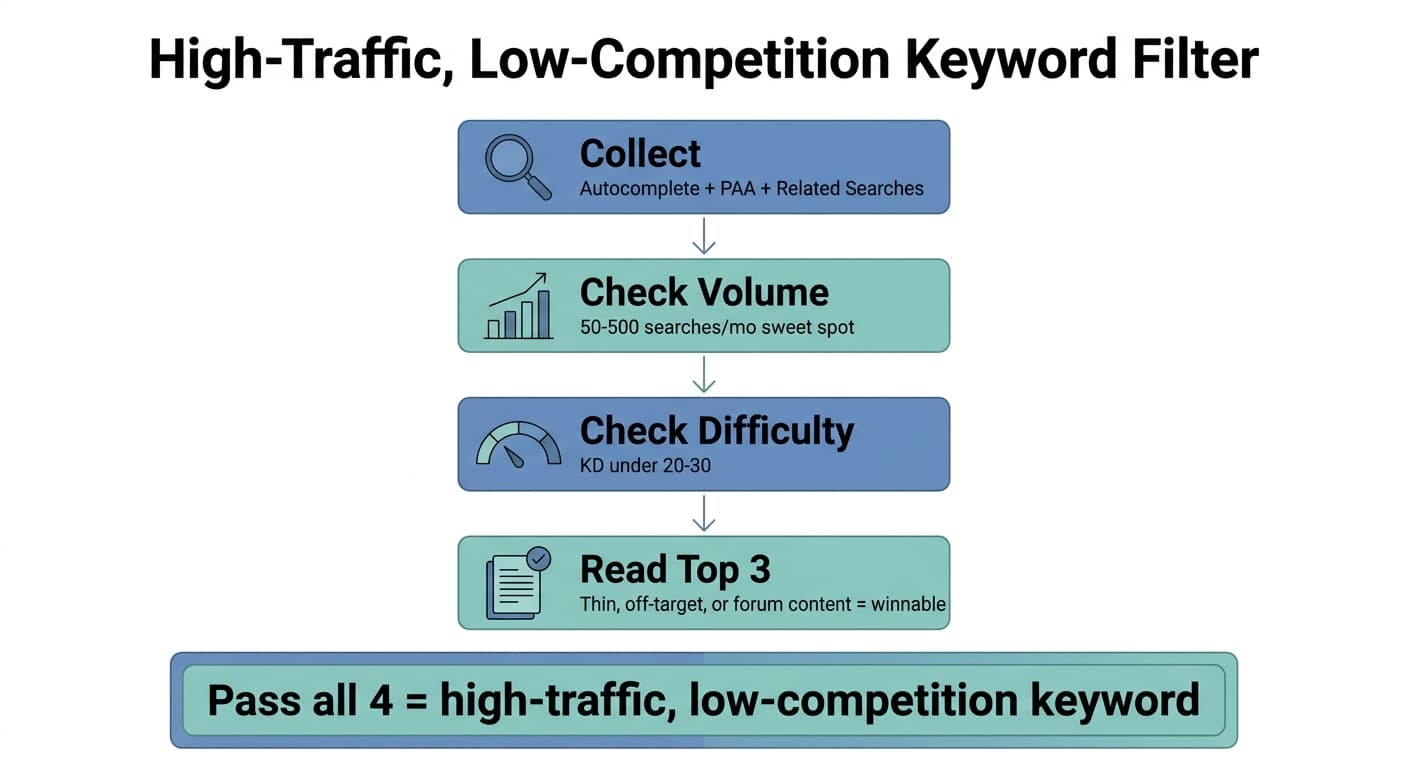
A practical rule of thumb: for a new or small site, a keyword with 50 to 500 monthly searches is usually the sweet spot. Below that, the traffic ceiling is too low to matter even if you rank number one. Above a few thousand, you are almost always competing with pages that have real backlink profiles, and the "low competition" half of the equation gets much harder to satisfy honestly. To see how much this check changes the picture, we ran a ready list of low competition keywords across 10 niches through it, and only 22 of the 50 ideas had any measurable US search volume.
Step 3: Filter for Low Competition With Two Signals, Not One
This is the step most guides skip or oversimplify. Two signals matter, and you need both.
Signal 1: Keyword Difficulty (KD) as a first filter, never the final word
Every keyword tool computes KD differently (some estimate backlinks needed, others estimate the strength of the ranking pages), but as a rough, tool-agnostic rule: <mark class="km-highlight" style="--hl:#FEF08A;background:#FEF08A">a KD under roughly 20 to 30 usually means a new or low-authority site has a real shot without years of link building</mark>. Treat this as a first pass that shrinks a long list to a manageable one, not a guarantee.
Signal 2: Actually look at who ranks (this is the step people skip)
KD scores are estimates. The only way to know if a keyword is genuinely winnable is to search it and read what is already there. Ask three questions about the current top 3 to 5 results:
- Are they thin? Under 800 words, a listicle with one line per item, or an obviously auto-generated page.
- Are they off-target? Answering an adjacent question instead of the one actually searched, or written for the wrong intent (a product page ranking for an informational query, for example).
- Are they community content, not publisher content? A Reddit thread, a Quora answer, or a five-year-old forum post ranking on page one is a strong low-competition signal. These pages rank because nobody has bothered to write a well-structured, dedicated answer yet, not because the topic is hard.
A keyword with a decent KD score but three strong, recent, comprehensive articles from established publishers in the top 3 is not actually low competition, no matter what the tool says. A keyword where the top 3 include a forum thread, a thin affiliate roundup, and a page that half-answers the query is low competition even if a tool scores it moderately.
Step 4: Cluster What You Find So You Don't Write the Same Page Twice
Once you have a filtered list, the next mistake is writing one article per keyword and accidentally creating five thin pages that all compete with each other, a problem search engines call cannibalization: multiple pages on your own site chasing the same query, splitting your authority instead of combining it.
Group your filtered keywords into topic clusters first. Keywords that share the same core intent and vocabulary belong in one article, not five. Murkuz's free keyword clustering tool does exactly this step: paste your list (one keyword per line, no login, no email, no credit limit, it runs in your browser), and it groups them by shared meaningful terms into tight clusters, then maps each cluster to a pillar-and-spoke plan, the broadest term in the cluster becomes your pillar page, and every narrower variation becomes a supporting article that links back up to it. It is a genuinely free tool with no signup wall, built specifically because clustering by hand for a long list is tedious and error-prone.
Lexical grouping like this misses synonyms that share no words. If your list is full of them, or you want Google's own grouping, the best keyword clustering tools for SERP-based and semantic grouping are compared side by side, with what each costs per 1,000 keywords.
Worked Example: Filtering a Real Seed Term
Here is the process end to end on one real topic, "keyword research for a new blog," to show the filtering in action rather than in the abstract.
| Step | What happened |
|---|---|
| Seed | Typed "keyword research for a new blog" into Google, expanded every PAA box |
| Raw candidates | 40+ variations collected: autocomplete suggestions, PAA questions, related searches, three Reddit threads |
| Volume check | Google Keyword Planner showed most core variations in the 10-100/mo range, a handful (like broader "keyword research tools") in the 1,000+/mo range |
| KD filter | Broad terms scored KD 40+ (dominated by Ahrefs, Semrush, established blogs); narrower long-tail variations scored KD under 20 |
| Manual SERP check | For the KD-under-20 group, top 3 results included two Reddit threads and one thin 600-word blog post for three separate variations |
| Verdict | The narrow, specific variations passed both filters: real (if modest) volume, and incumbents genuinely beatable with a proper, structured answer |
The pattern holds across niches: the broad, obvious version of a topic is almost always owned by established sites; the specific, oddly-phrased variations sitting one level down are where the real openings are.
A Note on Search Intent
Volume and competition are not the whole story. A keyword can pass both filters and still be the wrong target if the intent does not match what you can realistically publish. If the dominant SERP result type is product comparison pages, and your planned article is a pure how-to guide, you are fighting the format as well as the competitors. Check what actually ranks (blog posts, tool pages, forum threads, video) before committing, and match that format, not just the topic.
FAQ
How do I find low competition keywords with high search volume for free?
Build a seed list from Google Autocomplete, People Also Ask, and related searches, check real volume with Google Keyword Planner or Search Console, then manually read the current top 3 to 5 ranking pages for each candidate. If those pages are thin, off-target, or forum content rather than dedicated articles, the keyword is winnable regardless of what a difficulty score alone suggests.
What keyword difficulty (KD) score counts as low competition?
There is no universal number since every tool calculates KD differently, but a KD under roughly 20 to 30 is a broadly reliable first filter for a new or low-authority site. Treat it as a starting point, not a final answer; always check the actual ranking pages before committing.
Is there a free tool to find high-traffic, low-competition keywords?
Google Keyword Planner (volume), Google Trends (trend direction), and Google Search Console (your own impression data) together cover volume for free. For turning a long filtered list into a content plan without duplicating topics, Murkuz's keyword clustering tool is free with no login.
How much search volume is "high traffic" for a small or new site?
For most new or small sites, 50 to 500 monthly searches per keyword is a realistic, achievable target. Terms with thousands of monthly searches almost always carry stronger, better-resourced competition, making the "low competition" half of the equation much harder to satisfy honestly.
Why do some low-competition keywords still get no traffic once I rank?
Usually because the keyword had genuinely low search volume to begin with, or the search intent did not match what was published (an informational article targeting a transactional query, for example). Always verify volume with a real tool before writing, and confirm the dominant content type in the SERP before choosing your format.
Finding the keyword is only half the job. Once you have a filtered, clustered list, the harder and slower part is turning each cluster into a published, internally-linked pillar-and-spoke structure, then watching those pages for the moment they start slipping (which they eventually do, since almost all content decays over time). That ongoing detect-and-fix work is what Murkuz was built to run in the background: connect Search Console, and it surfaces which of your pages are losing ground, drafts the fix, and pushes it live, so keyword research turns into compounding traffic instead of a one-time list.
I have spent the last several years running SEO as the first growth channel for my own SaaS products before building Murkuz, and this keyword-first, competition-honest filtering process is the same one I use before writing anything, including this article.
Junaid Khalid, Founder of Ertiqah (builder of Murkuz)