A page that used to rank on page one is now sitting on page two, three, or gone from your rank tracker entirely. You already know it dropped. What you actually need is not another list of reasons rankings fall. You need the sequence of moves that gets a specific page back to where it was, in an order that actually works.
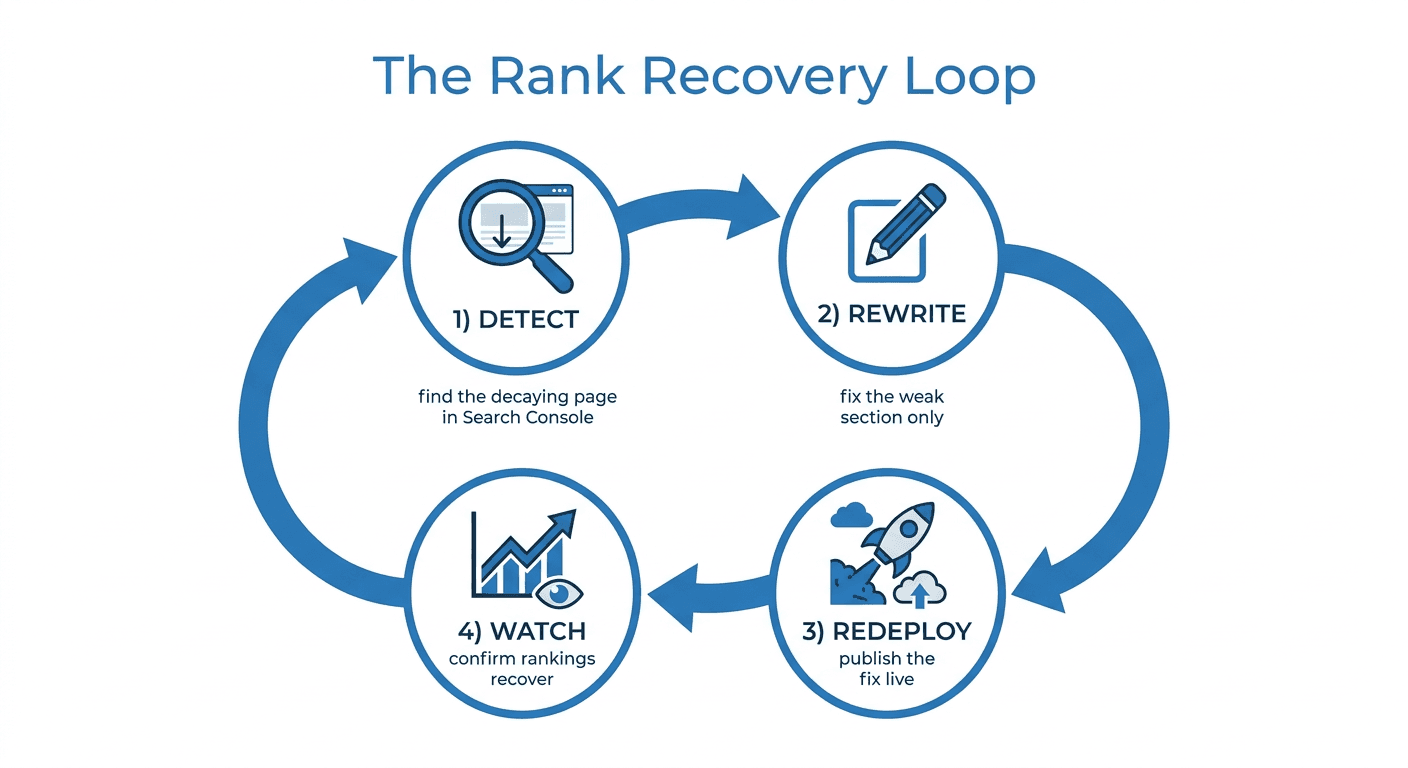
This is that sequence. Four repeatable stages: find the exact page and the exact reason it slipped, fix only the part that is actually weak, get the fix live, then confirm the ranking came back before you call it done. Most guides on this topic stop after stage one or two. This one walks through all four, because a diagnosis without a published, verified fix is not a recovery. It is a report.
Before You Start: Confirm This Page Needs Recovery, Not Diagnosis
Recovery and diagnosis are different jobs. If you have not yet confirmed why a page dropped, the fastest path is our SEO rankings dropped diagnostic, which walks through the six most common causes in order of likelihood: a false alarm, an algorithm update, a technical break, a stronger competitor, lost backlinks, or a manual action.
This playbook picks up specifically where that diagnostic points to content decay: the page didn't break, nobody penalized it, the world around it simply moved while the page stood still. Competitors published something more current. Your statistics aged out. Search intent shifted. If that is your situation, or you already know it is, keep reading. If you have not ruled out a technical issue or an algorithm update yet, run the diagnostic first. Rewriting content will not fix a broken canonical tag or an accidental noindex.
Stage 1: Find the Exact Page and the Exact Reason
Recovery starts narrower than most people think. Not "our blog is losing traffic," but one URL, one keyword cluster, one specific slide in position or impressions.
Pull the right report. Open Google Search Console, go to the Performance report, and filter by page. Compare the trailing 90 days against the 90 days before that using the built-in date comparison. Look for:
- A steady decline in average position across several months, not a single-day blip.
- Falling impressions even where position looks roughly stable, which usually means the page is starting to lose relevance for some of its queries before the ranking number visibly moves.
- A dropping click-through rate at a stable position, which usually means someone else's result got more clickable (a richer title, review stars, a better meta description) even from a worse slot.
Read what outranks you now. Search the exact keyword yourself and open whatever sits where your page used to sit. This single step tells you more than any tool: is it a genuinely deeper, more current piece, or did a SERP feature like an AI Overview or a featured snippet simply eat the space above the organic results? Those are different problems. One means write something better. The other means restructure for extractability, not necessarily add more words.
Isolate the actual gap. Do not assume the whole page is bad. Read your page section by section against the page that outranks you. Almost always, one or two sections are the actual weak point: a subtopic you cover in one thin paragraph that a competitor covers in three well-structured ones, a statistic three years out of date, a section written for a search intent that has since shifted from informational to commercial. The rest of the page is usually fine. Find the specific weak section before you touch anything.
This matters because the next stage only works if you know precisely what to fix. Rewriting an entire 2,000-word article top to bottom when 300 words of it are the actual problem wastes time and throws away everything Google already trusts about the parts that still work.
Stage 2: Rewrite the Weak Section, Not the Whole Page
A page that already ranked has earned something a blank page has not: some backlink equity, some engagement history, some existing trust. That is expensive to rebuild from scratch, which is exactly why a targeted rewrite beats a full rewrite in almost every case.
Update what is actually stale. Replace outdated statistics with the newest available source, not the number you happened to cite originally. If you cited a 2023 study in 2026, that alone can read as neglect to both readers and to the systems evaluating freshness.
Expand the section a competitor now covers better. This is the single highest-leverage move in a targeted rewrite. If the page that outranked you spends three paragraphs on a subtopic you cover in one sentence, that gap is very likely the actual reason it is ahead of you. Close it with real depth: specifics, a worked example, a short list, not padding.
Realign with today's search intent, not the intent when you wrote it. Reread the page as if you were searching the term for the first time today. If the dominant intent behind the keyword has shifted (informational to commercial, or a how-to that now expects a comparison), restructure the weak section around the current intent rather than layering more of the old angle on top of it.
Refresh anything visibly dated. Screenshots from a redesigned interface, a "current as of" date sitting in the copy, a tool or pricing reference that changed. These are small fixes with an outsized credibility cost when left stale.
Leave the rest alone. Do not touch headings, structure, or sections that are not the identified problem. Rewriting things that were not broken adds risk (a phrase that used to match a ranking query disappears) without adding benefit.
One rule that is easy to get backwards: only update the publish or "last updated" date after you have made a real, substantive change to the content. Changing the date on a page that received a cosmetic edit is a well-documented way to lose trust rather than build it, and both readers and search engines have gotten better at telling the difference.
A targeted rewrite that closes the one gap a competitor is winning on will outperform a full rewrite almost every time, because it keeps everything the page already earned intact.
Stage 3: Redeploy the Fix
This is the stage nearly every guide on this topic skips, and it is where most manual recovery attempts quietly die.
Here is the typical failure mode. Someone identifies the weak section, even writes the replacement copy, and then the draft sits in a doc waiting for whoever has CMS access to actually publish it. That person is mid-sprint on something else. A week passes. Two weeks. By the time the fix goes live, the window where a quick correction would have mattered has partly closed, and nobody remembers to check whether it worked because the fix took so long to ship that its own origin story got fuzzy.
Two things make this stage reliable instead of a bottleneck:
- Publish the fix as soon as it is written, not batched into a future content sprint. A ranking recovery is time-sensitive in a way new content usually is not: the page is actively losing position while the fix sits in a draft folder.
- Whoever writes the fix should also be able to publish it, or the handoff needs to be a single step, not a ticket that waits in a queue behind unrelated work. Every extra handoff between "the rewrite is done" and "it is live" is a place the fix can stall.
If you are doing this by hand across WordPress, Webflow, or Framer, that means giving the person doing the content work direct publish access for exactly this kind of fix, or a standing process where redeploys get same-day priority. If you are running this at any real volume (an agency managing decay across a dozen client sites, or a team publishing steadily enough that pages start aging out on a rolling basis), this is the stage worth automating first, because it is the stage where good diagnostic work goes to die on someone else's to-do list.
Stage 4: Watch for the Recovery, Don't Just Assume It
A published fix is not a proven recovery. Confirm it actually worked, and be honest with yourself about the timeline.
Set a realistic window. A targeted content refresh addressing genuine decay typically takes several weeks for Google to re-crawl the page, re-evaluate it, and adjust its position. This is not a same-day result like fixing a broken noindex tag. Expect a lag between "the fix went live" and "the ranking moved," and don't declare failure inside the first week.
Track the specific page and keyword, not the whole site. Site-wide traffic is too noisy a signal for one fix on one page. Watch that exact URL's average position and impressions in Search Console for the specific queries you were trying to recover, week over week.
Separate a real recovery from noise. Rankings move for reasons that have nothing to do with your fix: a competitor's own page changed, a small algorithm tremor happened to land the same week, seasonal demand shifted. If the position on your page climbs back roughly in the weeks after you published the fix, and nothing else about the surrounding SERP obviously explains it, that is a reasonable causal read. If it climbs while three other unrelated things also happened that week, be more careful about what you credit.
If it has not moved after a reasonable window, go back to Stage 1. Maybe the section you identified was not actually the competitive gap. Maybe a new competitor has since raised the bar again. Recovery is not always a single pass; sometimes it takes a second, sharper look at what is actually missing.
The habit that separates teams who reliably win back rankings from teams who just publish fixes and hope is this last stage. Skipping it does not just mean you miss the satisfaction of confirmation. It means you never learn which fixes actually work, so you keep repeating whatever you did last time whether or not it was the right move.
Why This Loop Breaks Down for Most Teams (and How to Close It)
Every stage above is doable by hand with Search Console, a spreadsheet, and someone who has CMS access. The tactics are not the hard part. The hard part, which is the actual subject of our content decay guide, is that the four stages above rarely happen as one connected sequence. In practice they happen as four separate, manually triggered tasks, spread across however many people and tools a team happens to have, and the handoffs between them are where recovery attempts quietly stall: the export nobody got around to, the rewrite that sat in a doc waiting for publish access, the fix that shipped but nobody circled back to check.
This is the specific gap Murkuz is built to close. Rather than treating detection, writing, publishing, and measurement as four separate tools you stitch together yourself, Murkuz runs them as one connected loop: it scans your Google Search Console data every morning and surfaces declining pages before the drop is obvious in a traffic dashboard, turns each one into a task with the actual performance history attached rather than a blank ticket, drafts the content refresh using a knowledge base of your brand voice and facts so the fix does not read like generic AI output, and pushes the approved fix straight to WordPress, Webflow, or Framer with one click rather than a manual copy-paste into your CMS. Afterward, it keeps tracking that specific page's position and shows you, in what Murkuz calls its Impact Scorecard, whether the fix you shipped actually correlates with the recovery, so "did that fix work" has an answer instead of a shrug.
You do not need a tool to run this playbook once, on one page. What a tool changes is whether you can keep running it, on every page that starts to decay, without each recovery depending on someone remembering to do all four stages in order before the trail goes cold. If you want to see the fuller case for treating this as a workflow problem rather than a writing problem, the content decay and rank recovery use case walks through it in more depth.
FAQ
How long does it take to recover lost rankings?
It depends on the cause. A technical fix, like removing an accidental noindex tag or correcting a canonical, can recover within one to two crawl cycles, often just days. A targeted content rewrite addressing genuine decay typically takes several weeks, since Google needs to re-crawl the page, re-evaluate it against the current competitive field, and adjust its position. Recovery tied to a broad algorithm update can take until the next related update cycle. Set your expectations by the cause, not by a single universal number.
Should I rewrite the whole page or just part of it?
Rewrite only the part that is actually weak in almost every case. A page that already ranked has earned link equity, engagement signals, and some existing trust that is expensive to rebuild from zero. Identify the specific section a competitor covers better, or the specific statistic that is stale, and fix that. A full rewrite only makes sense when the page's original angle or structure is fundamentally wrong for how the topic is understood today, which is rare.
How do I know if my fix actually caused the recovery?
Track the specific page and the specific keywords you were trying to recover, not site-wide traffic, and give it a realistic window (several weeks, not several days) before checking. If the position climbs back in the weeks following your fix and nothing else obvious changed in the surrounding search results during that window, that is a reasonable causal read. If several unrelated things happened at the same time, such as a competitor also updating their page or a known algorithm update rolling out, be more cautious about which one gets the credit.
What if the ranking still hasn't recovered after I fixed it?
Go back to Stage 1 and re-check your assumption about what was actually weak. It is common to fix the wrong section, especially if the competitive read was rushed. It is also possible that a new competitor raised the bar again in the weeks since you diagnosed the page, which means the gap you need to close has moved. Recovery sometimes takes a second, more precise pass rather than one attempt.
Is it better to consolidate two competing pages instead of recovering one?
If you have two pages on your own site targeting close to the same keyword, that is likely cannibalization rather than simple decay, and the fix is different: merge them into one stronger page rather than trying to recover both independently. Two mediocre, competing pages on the same site usually rank worse combined than one well-targeted page would alone.
Junaid Khalid is the founder of Ertiqah and the builder of Murkuz. He has run SEO as the first growth channel across his own SaaS products, which meant living through this exact recovery sequence, by hand, on his own pages, long before building a tool to run it automatically.