Most SEO for startups advice was written for a company that already has a marketing budget, a content team, and a domain with ten years of authority behind it. You have none of those things. You have a product, a small team, and maybe a few hours a week not already spoken for by shipping features and talking to customers.
That constraint is not actually a disadvantage. A brand-new site with zero authority cannot win a fight for "seo tools" or "project management software," and trying to is how most startups waste their first six months of content. But a founder willing to target specific, low-competition questions, answer them properly, and treat the resulting pages as an asset to maintain rather than a box to check, can out-rank agencies and incumbents on exactly the terms that matter: the ones your actual buyers are searching. This playbook is written for exactly that founder, the same audience Murkuz built its founder-focused workflow around.
This is a practical playbook for doing that with no budget, built around one idea: <mark class="km-highlight" style="--hl:#FEF08A;background:#FEF08A">SEO works as a startup's first growth channel precisely because it compounds while you sleep</mark>, which is the opposite of every paid channel you are also weighing right now.
Why "Zero Budget" Is Actually a Strategy, Not a Limitation
Founders often treat "we have no SEO budget" as a problem to apologize for. It is closer to a forcing function that keeps you from making the single most common mistake in startup SEO: chasing volume instead of intent.
A funded competitor with an agency retainer can afford to publish fifty mediocre, high-volume-keyword posts and hope a few stick. You cannot, and you should not want to. Zero budget means every piece of content has to earn its place, which pushes you toward the keywords that actually convert: specific, lower-volume, high-intent searches from people who already know they have the problem your product solves.
This is also why paid ads and SEO are not really substitutes for each other at this stage. Ads stop producing traffic the moment you stop paying. A page that ranks for a real question keeps earning visits, and eventually signups, for years with no further spend. For a startup with a long runway to protect, that difference in economics matters more than almost any other marketing decision you will make this year.
Step 1: Pick Keywords You Can Actually Win
Keyword research for a new site is not about finding the biggest number. It is about finding the intersection of three things: real search volume (even if it is small), low competition (so a brand-new domain has a real shot), and intent that matches what your product actually does.
Concretely, that means:
- Ignore head terms entirely for now. "SEO," "CRM," "project management" are owned by sites with years of backlinks and domain authority you cannot manufacture. Competing there is not ambitious, it is a waste of your only scarce resource: time.
- Target long-tail, specific phrasing. "Project management tool for solo consultants" beats "project management software" for a new site, even though the volume is a fraction of the size, because you can actually rank for it within months instead of years.
- Prioritize "versus" and "alternatives" content early. Someone searching "[competitor] alternatives" or "[your category] vs [competitor]" has already decided to switch tools and is choosing between options right now. This is the highest-intent, easiest-to-win content type available to a startup, and it doubles as sales collateral your team can send on calls.
- Check the difficulty before you write a word. A free keyword tool or even a manual look at who currently ranks tells you fast whether page one is dominated by billion-dollar sites (skip it) or by thin forum threads and generic listicles (write something better and take the spot).
| Keyword type | Example | Why it fits a zero-budget startup |
|---|---|---|
| Competitor alternative | "[competitor] alternatives" | Highest intent, lowest volume needed, doubles as sales content |
| Feature + role | "[feature] for freelancers" | Matches a specific buyer, low competition, converts well |
| Problem-first | "how to [specific outcome]" | Answers a real question, builds trust before the pitch |
| Category head term | "project management software" | Skip for now. Owned by incumbents with years of authority |
The pattern across the winnable rows: specific enough that a big incumbent has not bothered to target it directly, but real enough that actual buyers are typing it into Google every month. For worked examples, here are 50 keyword ideas we checked for volume and difficulty across 10 niches, with the real US numbers for each and a two-minute check you can run on your own list.
Free tools carry a startup a long way here, but there is usually a point where a paid research suite becomes the next sensible spend. What the paid research suites actually cost sets out entry pricing for Ahrefs, Moz and Semrush, so the first subscription is a decision rather than a guess.
Step 2: Turn Your Product Into a Content Engine
This is the move a startup can make that an agency working from a keyword spreadsheet cannot: you have direct access to what your actual users are confused about, searching for, and asking on sales calls. That is a content backlog no external tool can replicate.
Go looking in four places:
- Support tickets and onboarding questions. If three different customers asked the same question this month, that is a page waiting to be written, and it will convert better than a generic blog post because it answers a question your actual market has.
- Sales call objections. Whatever your team hears repeatedly ("does this integrate with X," "how is this different from Y," "can it handle Z") is a comparison page or FAQ answer you have not written yet, and it is already proven to matter because a real prospect asked it out loud.
- In-app search and help-center queries. What are people typing into your own search bar? That is unfiltered demand data from people who are already inside your product.
- Feature pages nobody has written yet. A feature with strong adoption and few support questions is proof of a use case worth its own dedicated page, one that names the specific job it does for a specific kind of user.
Writing from this backlog does two things at once: it produces content that ranks because it answers a real, specific question, and content that converts, because the questions came from people already close to becoming customers. If your startup sells software, the same idea runs through our guide to SEO for SaaS, which puts product-mined content second only to fixing pages already close to page one.
Step 3: Fix the Basics So Google Can Actually Find You
None of the keyword or content work above matters if your site has technical problems blocking it from being indexed properly. This is the unglamorous, one-time setup every startup should knock out in a single afternoon:
- Connect Google Search Console immediately, even before you publish your first article. It is free, it shows indexing errors, and it is the single most useful piece of data you will have for the rest of this playbook.
- Submit a sitemap so Google can find every page on your site without having to stumble across it by chance.
- Make sure your site is mobile-friendly and reasonably fast. You do not need a perfect Core Web Vitals score. Google's own developer advocates have said publicly that page experience is not a tie-breaker in rankings and that chasing a "perfect score" will not move your rankings. Get the basics solid, then spend your remaining time on content.
- Write real title tags and meta descriptions. Your title tag should include the keyword, stay under 60 characters, and actually describe the page. A five-minute task per page that a surprising number of startups skip.
- Fix broken internal links and duplicate pages as you go, before they accumulate into a bigger cleanup later.
This step takes a day, not a quarter. Do it once, early, and move on to the content that actually drives rankings and signups.
Step 4: Write Content That Beats What Is Already Ranking
Once you have a keyword worth targeting, the job is not to write "an article about it." It is to look at what currently ranks for that exact query and make something clearly better, because "as good as" the top three results is not enough to move a brand-new domain onto page one.
Concretely, before writing:
- Read the current top three results. What do they cover, and what do they miss? Are they thin, outdated, or genuinely useful? Most SEO content for competitive-adjacent topics is written to satisfy a word count, not to help the reader, and that gap is exploitable.
- Match the search intent exactly. If someone wants a comparison, give them a table, not prose making the same argument three ways. If they want a how-to, give them steps, not a think-piece.
- Structure for skimmability. Short paragraphs, real subheadings, bullets where a list is genuinely a list. Nobody reads a startup blog post top to bottom; they scan for the part that answers their exact question.
- Add something the incumbents do not have. A worked example, an opinionated recommendation instead of hedged "it depends," a comparison table, or a genuine FAQ. Being helpful and specific beats being long.
This is also where AI search readiness matters more than most startup guides admit. Put a direct, self-contained answer to the query in the first two or three sentences after your heading, not buried under paragraphs of throat-clearing. AI answer engines tend to extract and cite the passage that most cleanly answers the question, and a startup writing that way from day one has a real shot at being the brand ChatGPT or Google's AI Overview recommends by name, in a landscape almost nobody has caught up to yet.
Step 5: Do Not Stop at "Published." Watch What Happens Next
Here is the part every single "SEO for startups" checklist skips, and it is the single biggest reason startups burn months of content effort with nothing to show for it: publishing is not the finish line.
A page that ranked well three months ago can quietly slide for reasons that have nothing to do with the quality of the writing: a competitor published something fresher, your product added a feature the page never mentions, or a stat you cited got stale. Most founders never notice, because they are heads-down building product, which is exactly where their attention should be, and exactly why this step gets skipped.
The fix is a habit, not a bigger content calendar: check your Search Console data on a regular cadence, and when a page starts slipping, treat that as a signal to refresh it, not to write something new and hope. Update the stat, tighten the answer, add the feature that shipped since you wrote it, republish. A ten-minute refresh on an existing page usually beats starting from zero, because that page already proved Google will show it for this query.
This is the exact gap Murkuz is built to close for teams with no bandwidth to manually re-check every page they have published. It scans your Search Console data daily to catch pages losing rank before the drop shows up in your analytics, turns each one into a task with the specific fix attached, and once you approve the refresh, tracks whether the ranking actually recovered, showing the causal link between the fix and the result rather than just a traffic chart. For a founder-run marketing function, that is the difference between SEO that compounds and SEO that quietly decays while you are busy building the product.
A Realistic First-Month Plan
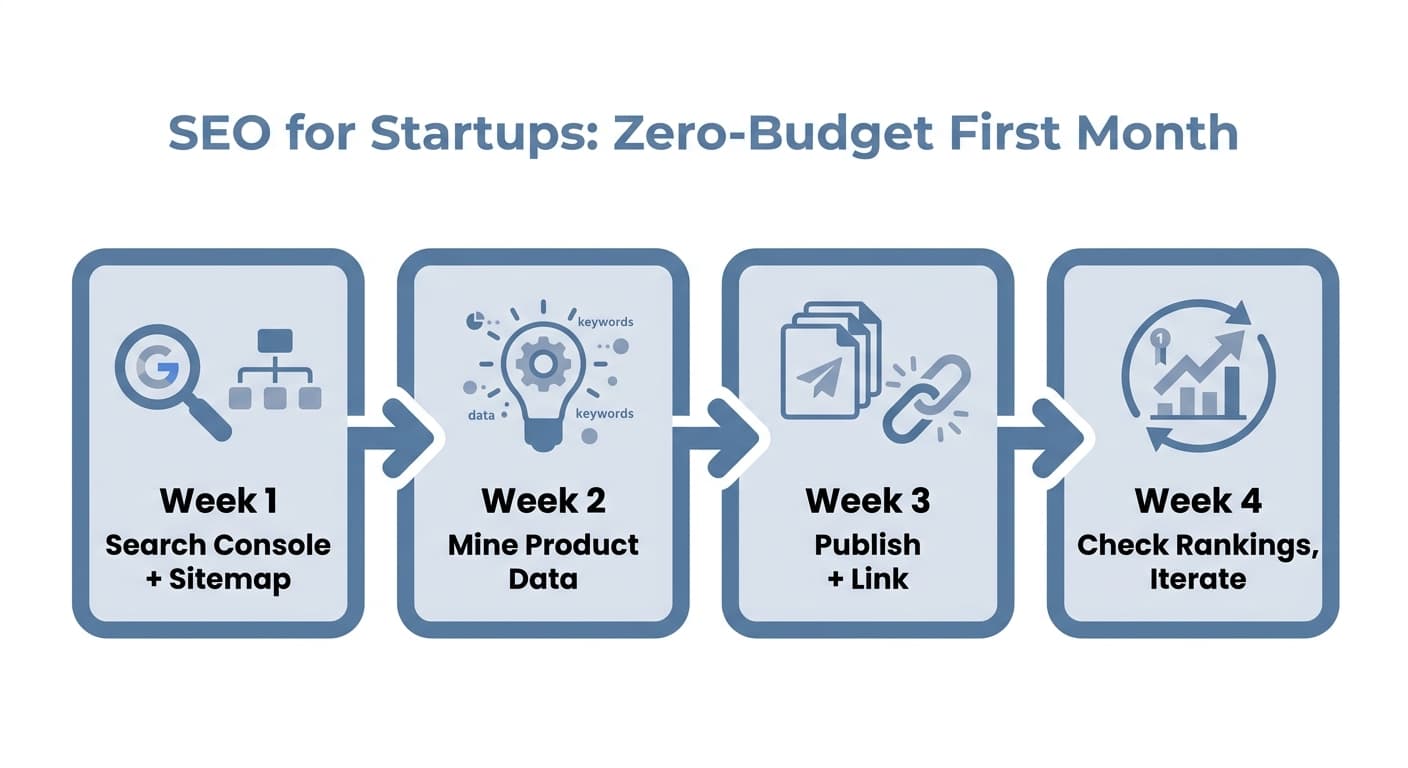
If you are starting from genuinely nothing, here is the order that gets you to your first rankings the fastest:
- Week 1: Connect Google Search Console, submit your sitemap, and fix any glaring technical issues (broken links, missing mobile support). Pull your first list of ten winnable keywords using the criteria in Step 1.
- Week 2: Mine support tickets, sales call notes, and in-app search data for your first five article topics. Write and publish the first two, structured to beat whatever currently ranks for that exact query.
- Week 3: Publish two more, prioritizing at least one competitor-alternative or comparison page. Set up internal links between everything you have published so far: your pages should link to each other and to your product pages, not sit as isolated islands.
- Week 4: Check Search Console for early signals: impressions, average position, and which queries you are starting to show up for even outside your target list. Use that data to pick your next batch of keywords, and put a recurring reminder on your calendar to re-check older posts monthly once you have a few months of content live.
None of this requires hiring anyone or paying for an expensive tool stack. It requires roughly the same discipline you already apply to shipping product: pick the smallest winnable thing, ship it, measure what actually happened, and iterate.
FAQ
How long does SEO take to work for a new startup?
Expect your first meaningful rankings within two to three months for genuinely low-competition, long-tail keywords, and real, compounding traffic starting around month four to six if you publish consistently and keep the technical basics solid. Broad, competitive terms can take much longer, sometimes over a year, which is exactly why the playbook above starts with winnable keywords instead of ambitious ones.
Can a startup do SEO with literally no budget?
Yes. Google Search Console is free, the highest-intent keyword ideas come from your own product and customer conversations rather than a paid tool, and the writing costs time, not money. A budget helps you move faster, but the core playbook works with zero cash outlay.
Should an early-stage startup hire an SEO agency or do it in-house?
In-house almost always wins early on, because nobody outside your company understands your product and customers' real objections well enough to write the highest-converting comparison and feature pages. An agency becomes worth considering once you have product-market fit and need to scale volume or handle complex technical SEO, not before.
What is the biggest SEO mistake startups make?
Chasing high-volume, generic keywords that established competitors already own, instead of targeting the specific, lower-volume questions a brand-new site can actually rank for. A close second: publishing content and never checking on it again, so pages that once ranked quietly decay unnoticed.
Do startups need to worry about AI search like ChatGPT and Google's AI Overviews?
Yes, and it is a genuine opportunity because almost no early-stage company has a concrete plan for it beyond "write good content." Put a direct answer near the top, use real tables and bullets, and answer FAQ-style questions in the exact phrasing people use. That structure is what gets a passage extracted and cited by name in an AI answer.
What is the fastest type of content for a startup to rank with?
Competitor-alternative and "X vs Y" comparison pages, plus specific feature-for-role pages ("[feature] for freelancers," "[feature] for agencies"). Both have lower volume than broad category terms, which is exactly why a new site can win them, and both attract visitors already close to a buying decision.
Junaid Khalid is the founder of Ertiqah, the company behind Murkuz. He has run SEO as the first growth channel across his own SaaS products, including the early, zero-budget stage this playbook describes, which is the reason Murkuz exists: to close the loop between finding an SEO problem and proving it got fixed. Once you have more than a handful of pages live, the SaaS SEO strategy guide goes deeper on the pipeline-first approach that follows this early stage.